
Clothes moth treatment pricing varies more than most other household pests, mainly because the size of the job depends heavily on how many rooms are affected and how much preparation the homeowner has already done. Here’s what actually drives the cost, and what a fair quote should include.
Across London, professional clothes moth treatment for a single-bedroom infestation generally starts in the region of £100-£180 for one visit, with whole-property treatments covering multiple bedrooms typically running higher, often £250-£350 when two follow-up visits are included. Council-run pest services and private pest control companies both operate in a broadly similar range, though private landlords and larger properties tend to sit toward the top end.
Most reputable providers will include at least one follow-up visit roughly two weeks after the first — Lambeth Council’s moth treatment process, for example, runs to two visits, two weeks apart, since moth eggs that survive the initial treatment can still hatch afterwards and a single visit rarely resolves an established infestation on its own.
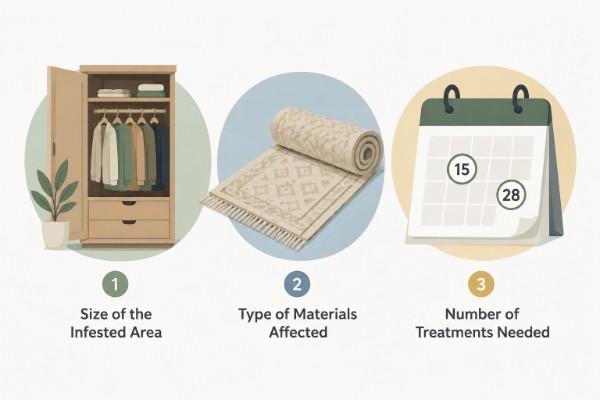
This is the single biggest factor. A treatment limited to one bedroom costs significantly less than a whole-flat treatment covering a bedroom, living room, and hallway carpet, since each additional room adds both product and technician time.
A localised problem in one wardrobe is a much smaller job than an infestation that’s spread into carpets, upholstered furniture, and multiple storage areas. Pest controllers will usually want to inspect before quoting a final price for this reason.
Because moth eggs can survive an initial treatment and hatch days or weeks later, a proper course of treatment usually includes at least one repeat visit. Quotes that only cover a single visit with no follow-up are often cheaper upfront but may not fully resolve the problem.
Treatments are far more effective — and sometimes cheaper overall — when the homeowner has already done the prep: washing or dry-cleaning affected items, vacuuming thoroughly, and clearing furniture away from walls. Properties that need more prep work done on the day, or where access is difficult, can attract a higher charge.
For a single damaged item with no wider signs of infestation, washing or dry-cleaning at a high temperature and thorough vacuuming can be sufficient without paying for a professional visit. It’s worth spending time checking nearby drawers, carpet edges, and storage boxes before assuming the problem is contained, since moth larvae are easy to miss.