
Most ant problems in London homes respond well enough to a can of spray and a bit of patience. Pharaoh ants are the exception — and for anyone who’s already reached for the nearest insecticide, it’s worth knowing that this is the one ant species where that instinct can genuinely backfire.
Pharaoh ants are easy to miss at first because they’re so small — around 2mm long, roughly a quarter the size of the common black garden ant. They’re pale yellow to light brown, sometimes described as translucent, with a slightly darker abdomen. Rather than the single foraging line you’d expect from garden ants heading to a sugar bowl, pharaoh ant trails often look more like fine branching veins spreading across a wall or worktop, since foragers move to and from multiple points at once.
Unlike garden ants, pharaoh ants are almost never found outdoors in the UK. They need warmth to breed — ideally above 18°C — which means they live entirely indoors, favouring the warm, hidden spaces near boilers, heating pipes, behind kitchen appliances, and inside wall cavities.
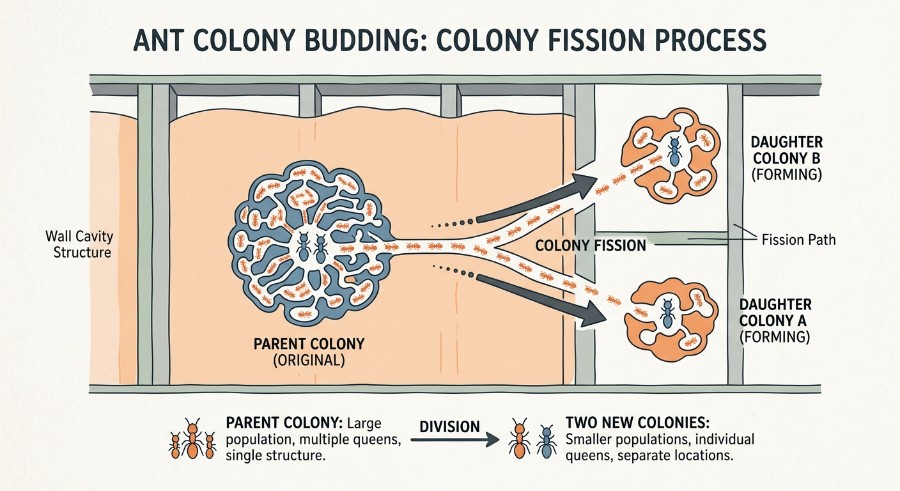
A garden ant nest has one queen and a single, contained colony. Pharaoh ant colonies are structured completely differently: a single colony can contain multiple queens and tens of thousands of workers, and — critically — the colony can split itself into satellite sub-colonies that relocate to a new area of the building. This is sometimes called “budding,” and it’s the reason pharaoh ants can turn up in a completely different room, or even a different flat in the same building, within days.
This is the part most people don’t expect. Conventional ant sprays and surface insecticides kill on contact, which sounds like exactly what you want — but pharaoh ants respond to the presence of a threat by budding: worker ants carrying eggs, larvae, and even a queen will split off from the main colony and relocate away from the treated area. Bolton Council’s pharaoh ant guidance warns that traditional insecticides can actually encourage the spread of the ants, since the colony will avoid treated areas rather than being eliminated by them — scattering the infestation into new, harder-to-find locations throughout the building instead of resolving it.
This is why professional treatment for pharaoh ants relies on slow-acting baits rather than sprays. Baits are designed to be carried back to the nest and shared throughout the colony, including to the queens, before the ants realise anything is wrong — which avoids triggering the defensive budding response that sprays cause.