Most people assume all ants in a London home are the same problem with the same fix. In reality, the two species you’re most likely to encounter — the black garden ant and the pharaoh ant — behave so differently that treating one like the other is one of the most common reasons DIY ant control fails.
Size and Colour
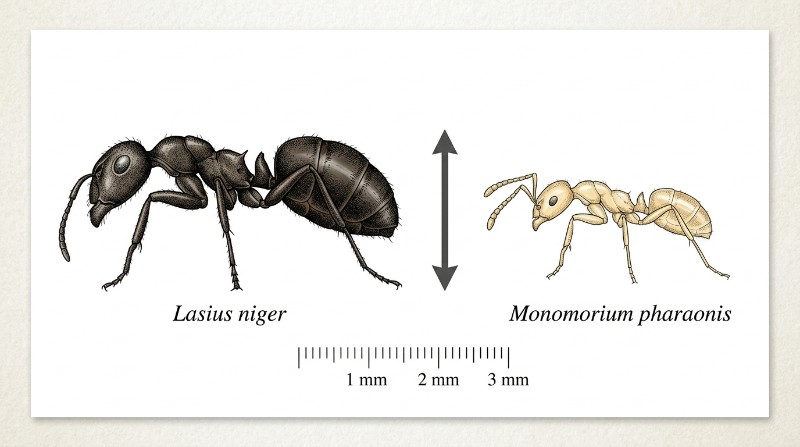
Garden ants are dark brown to black and relatively large as UK ants go, with workers around 4-5mm long. Pharaoh ants are roughly a quarter of that size — pale yellow to light brown, around 2mm long, and easy to mistake for a speck of debris until you look closely.
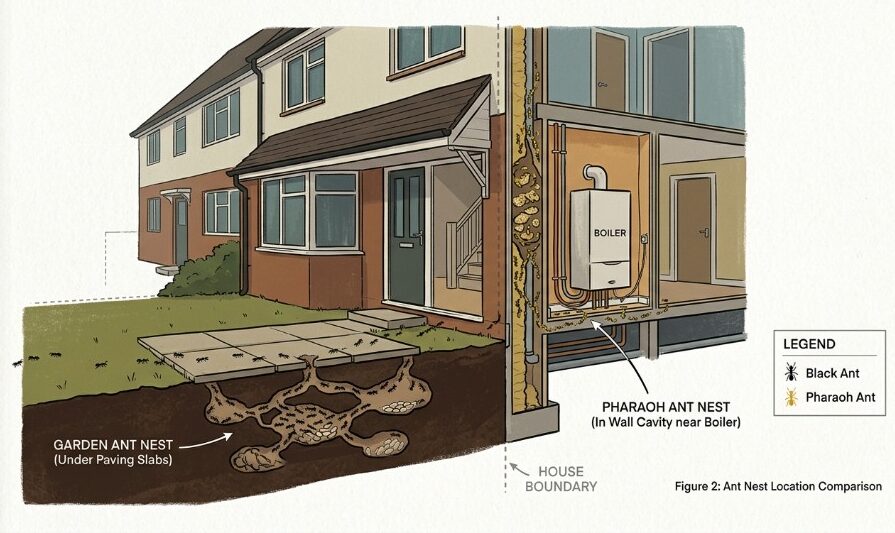
This is the clearest way to tell them apart. Garden ants nest outdoors — in lawns, flower beds, under paving, or at the base of walls — and only come inside to forage for food, usually along a single visible trail leading back out to the garden. Pharaoh ants are the opposite: Knowsley Council’s ant guidance confirms pharaoh ants are only found indoors, since they need warm, humid conditions to breed and gather near central heating systems and other heated indoor areas, nesting in wall cavities, behind appliances, and near boilers or heating pipes rather than outdoors.
 Seasonal Behaviour
Garden ants have a very distinct seasonal pattern: winged queens and males swarm from the nest on a handful of warm days in mid-to-late summer — the phenomenon often called “flying ant day” — mate in the air, and then the queens shed their wings to start new nests. Outside of that swarming window, garden ant activity is largely limited to warmer months. Pharaoh ants show no such seasonality. Because they live in heated buildings year-round, activity can continue through winter just as easily as summer.
A garden ant colony is a single, self-contained nest with one queen. A pharaoh ant colony can contain multiple queens and, critically, can split into satellite sub-colonies that relocate elsewhere in a building when disturbed — a behaviour garden ants simply don’t show.
| Garden Ants | Pharaoh Ants | |
|---|---|---|
| Nest location | Outdoors | Indoors only |
| Effective treatment | Direct spray or dust on the nest | Slow-acting bait carried back to the colony |
| Response to spraying | Nest is destroyed | Colony can split and spread |
| Typical timeframe | Often one visit | Multiple visits over weeks |
A DIY spray that works perfectly well on a garden ant trail heading out to the lawn can make a pharaoh ant problem worse, since spraying triggers the colony-splitting response covered in our identification guide. Correctly telling the two apart before reaching for a treatment is the single biggest factor in whether DIY control succeeds or backfires.