
Silverfish and booklice are often confused, and it’s easy to see why — both turn up in damp corners of a home, both are linked to paper and books, and both are considered a sign of excess moisture rather than a serious pest. But they’re different insects with different treatment needs, and telling them apart starts with a good look at size.
Size Is the Biggest Giveaway
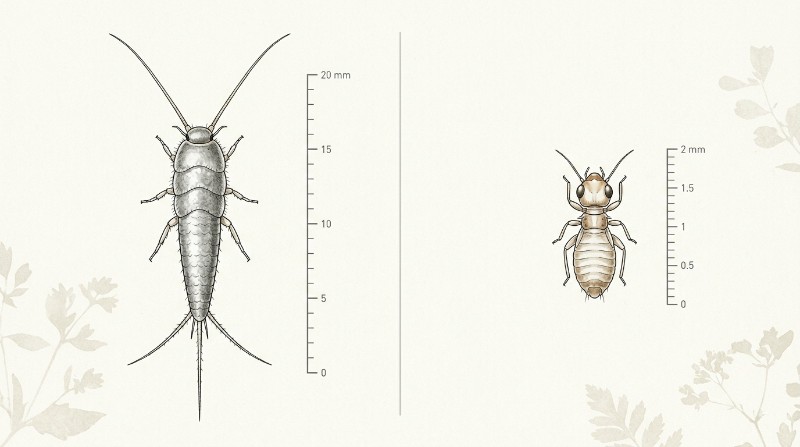
Silverfish are relatively large as household insects go, growing to around 12mm — easily visible and unmistakable once seen. Booklice are dramatically smaller — Birmingham City Council’s booklice advice leaflet puts them at normally around 1.5-2mm long, rarely exceeding 6mm — closer to the size of a full stop than an insect most people would notice without looking closely. If you’re spotting something crawling that’s genuinely tiny — often mistaken at first for a speck of dust that moves — booklice are the more likely culprit.
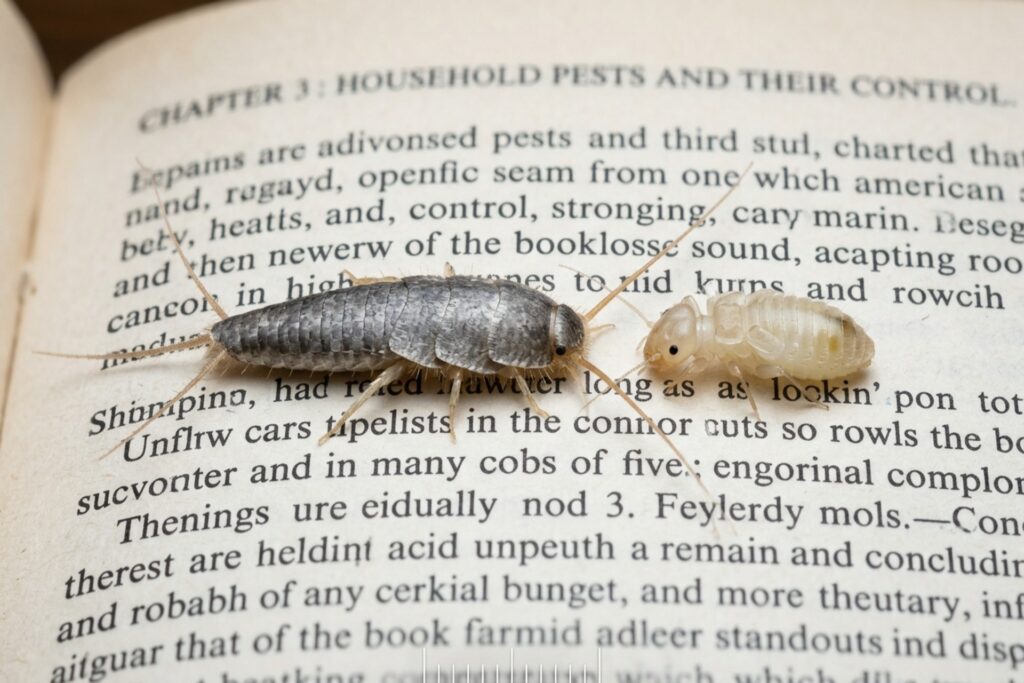
Silverfish are silvery, scaly, and tapered, with three tail-like filaments at the rear and a fast, wriggling movement. Booklice are soft-bodied, wingless, and pale — translucent white through to tan or grey — with a distinctively bulging front of the head. They move much more slowly than silverfish and don’t have the same tapered, torpedo-like shape.
What They Eat and Where They’re Found
Both are drawn to warm, humid conditions, but their diets differ in an important way. Silverfish feed on starches and carbohydrates — wallpaper paste, book bindings, cardboard. Booklice feed primarily on mould and fungi, which is why they’re so often found on damp books, in cardboard boxes that have absorbed moisture, or around leaking or sweating pipes — anywhere mould growth can get a foothold. A booklice infestation is, if anything, an even more direct signal of active mould than a silverfish sighting.
Silverfish tend to appear as scattered individual sightings. Booklice, by contrast, can appear in far larger numbers very quickly, since they reproduce prolifically in the right conditions and are often first noticed as a cluster of tiny moving specks rather than a single insect.
Because both pests are moisture-driven, the underlying fix — reducing humidity, fixing leaks, improving ventilation — is similar for both. But because booklice feed on mould rather than starchy material, a booklice infestation often means there’s active mould growth to deal with directly, not just general damp, which can change what needs addressing alongside pest treatment.