Most spider sightings in London homes fall into one of two very different categories: the large, fast-moving giant house spider that turns up on the carpet at night, and the smaller, web-dwelling false widow tucked into a corner. Confusing the two is common, but they look and behave quite differently once you know what to check.
The giant house spider is one of the UK’s largest, with a leg span that can reach up to 7.5cm — genuinely startling when one runs across an open floor. Its body is elongated and covered in fine hairs, dark orange-brown in colour. False widows are much smaller and a completely different shape: a compact, bulbous, glossy abdomen, with the largest species reaching a body length of around 8.5-11mm, not including legs.
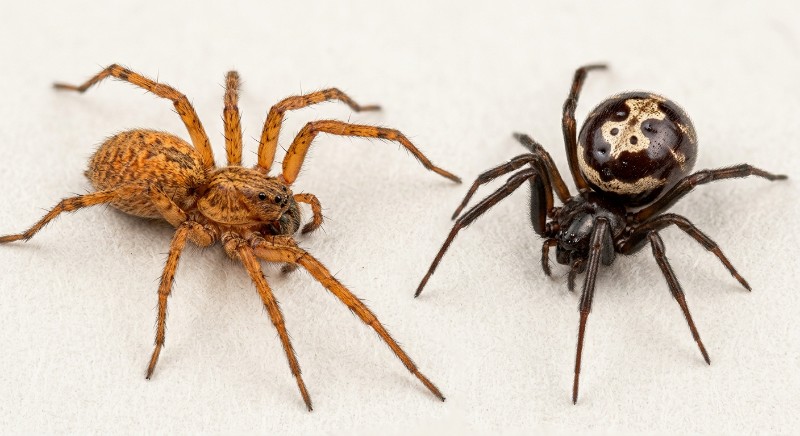
Giant house spiders are a fairly uniform orange-brown with subtle patterning along the body. False widows have a distinctive dark brown to black bulbous abdomen with cream-coloured markings that are often described as skull-shaped, and noticeably reddish-orange, spindly legs that stand out against the darker body.
This is often the clearest giveaway. Giant house spiders are runners, not web-sitters — they’re the ones seen sprinting across open floor space, particularly at night, especially during autumn when males roam in search of a mate. They typically live under furniture, in corners, or in dark undisturbed spaces, and only build a small funnel-shaped web as a retreat rather than a large hunting web.
False widows, by contrast, are consistently web-dwellers. Redbridge Council’s pest control guidance describes their typical web as a loose tangle with a silk tube leading into a crevice where the spider hides during the day, usually built at least 1.5 to 2 metres above ground level around window and door frames or eaves, and they tend to stay near that web waiting for flying insects rather than roaming across open floors.
Neither species poses a meaningful health risk. Giant house spiders are not known to bite people in any notable way and are considered entirely harmless. False widows can bite, but only rarely and typically as a result of being handled or trapped against skin — with symptoms usually no worse than a wasp sting.
| Giant House Spider | False Widow | |
|---|---|---|
| Size | Up to 7.5cm leg span | 8.5-11mm body length |
| Colour | Orange-brown | Dark brown/black with cream markings |
| Behaviour | Fast-moving, runs across floors | Stays near its web |
| Typical location | Under furniture, dark corners | Corners of windows, eaves, door frames |
| Bite risk | Essentially none | Rare, mild if it happens |